
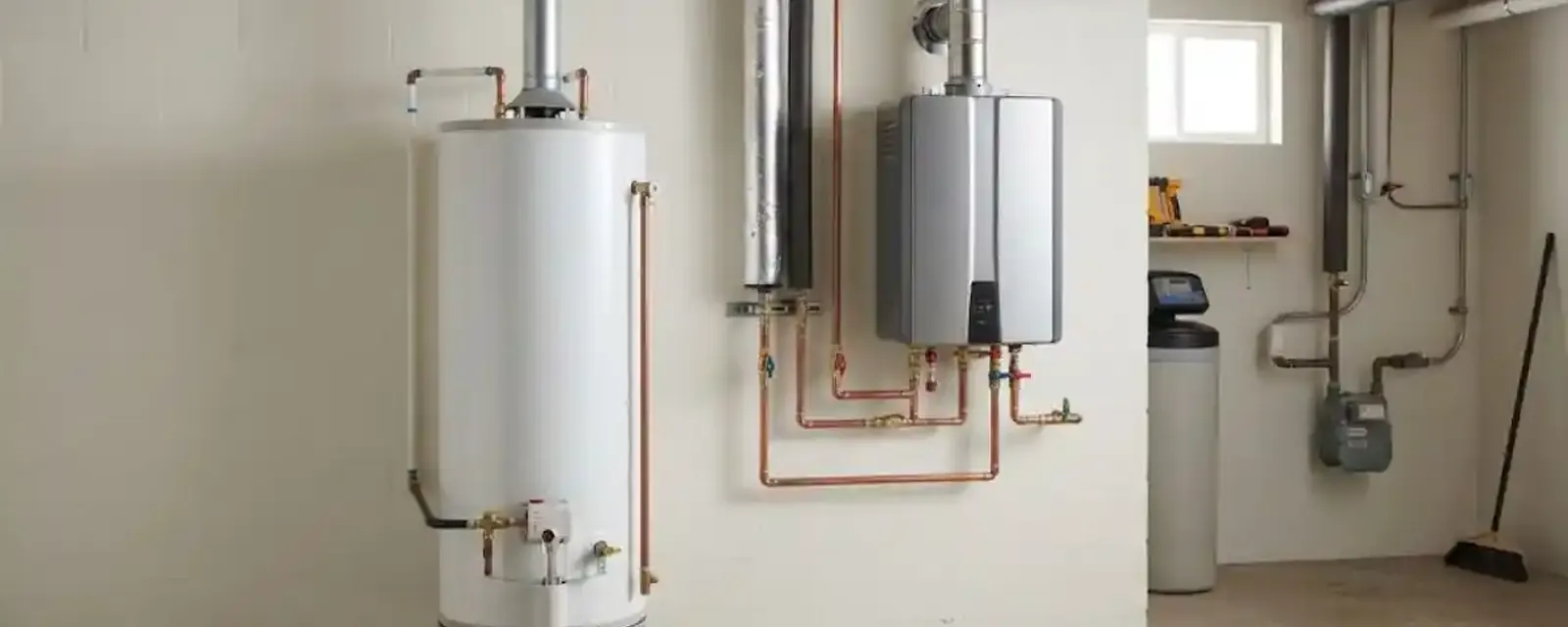
Is tankless worth it in a Huntsville home?
A tankless unit avoids standby heat loss and never runs out in the middle of a long shower, which is its best selling point. It also costs more up front and often needs a larger gas line and new venting. The gas line size is the number one hidden cost, so ask for it to be checked before you pick a model.
For a household with steady daily hot water use and a long-term plan to stay, tankless can make sense. For a rental or a short stay, a standard tank from water heater installation is often the better value.
Flush and descale: the maintenance people skip
Minerals in water leave scale inside the heat exchanger, which reduces flow and efficiency and can trigger error codes. A flush with a descaling solution removes that buildup. Most manufacturers recommend flushing on a regular schedule, and the plumber can tell you which one applies.
The City of Huntsville's report gives no hardness figure, so test your tap or ask the utility. Hard water makes flushing more urgent. A water softener can reduce scale, and the water softener and filtration page covers when one is worth considering.
Common tankless problems
Many of these are fixable. A plumber reads the error code, checks the gas supply and inlet filter and flushes the unit before suggesting a larger repair or a replacement.
- Error codes: often a scale, vent or gas supply fault.
- Cold water sandwich: short bursts of cold in the middle of a shower.
- Low flow: clogged filter or scaled exchanger.
- No ignition: gas supply, flame sensor or venting issue.
- Leak: seals or a cracked exchanger.
Tankless installation basics
- Confirm the gas line size, vent type and electrical needs for the model you want.
- Mount the unit, run the vent and connect water, gas and condensate lines.
- Add isolation valves so the unit can be flushed.
- Test flow, temperature and safety shutoffs and walk through the control panel.
Sizing: why flow rate matters
A tankless heater is sized by how much water it heats per minute and how much it raises the temperature. A house with two showers and a dishwasher running together needs a bigger unit than one with a single bath. Groundwater temperature in winter is lower, so the same unit delivers less hot water then.
Ask the plumber to size from your fixtures, not from a guess, and to explain the flow limit before you buy.
Tankless versus tank in practice
| Tankless | Tank | |
|---|---|---|
| Hot water supply | Continuous within flow limit | Limited to tank volume. |
| Space | Compact, wall mounted | Floor space needed. |
| Upfront cost | Higher | Lower. |
| Maintenance | Yearly flush | Annual drain, anode check. |
| Lifespan | Often longer with care | Roughly 8 to 12 years. |
What drives tankless pricing
Insurance does not cover wear or scale damage, but may cover sudden water damage. Call for a price on your model.
A tankless install is made to the International Plumbing Code (IPC), which the City of Huntsville lists at its 2024 edition, alongside the International Fuel Gas Code for gas units.
Tankless water heater questions
Planned tankless installs are scheduled. For a failed unit with no hot water, call the 24/7 line and a plumber is dispatched.
Many manufacturers suggest yearly, more often in hard water. Your unit's manual states the schedule.
Codes usually point to a scale, venting or gas supply issue. The plumber reads the code and checks that system.
Yes, but the gas line, venting and electrical often need upgrades. The plumber checks before quoting.
Not always, but hard water scales the heat exchanger. Test your tap first.